

Tokayev highlights record trade, the Middle Corridor, digital transformation and expanding cooperation with China
By: Dr. Abdulrahim I. Abdulwahid
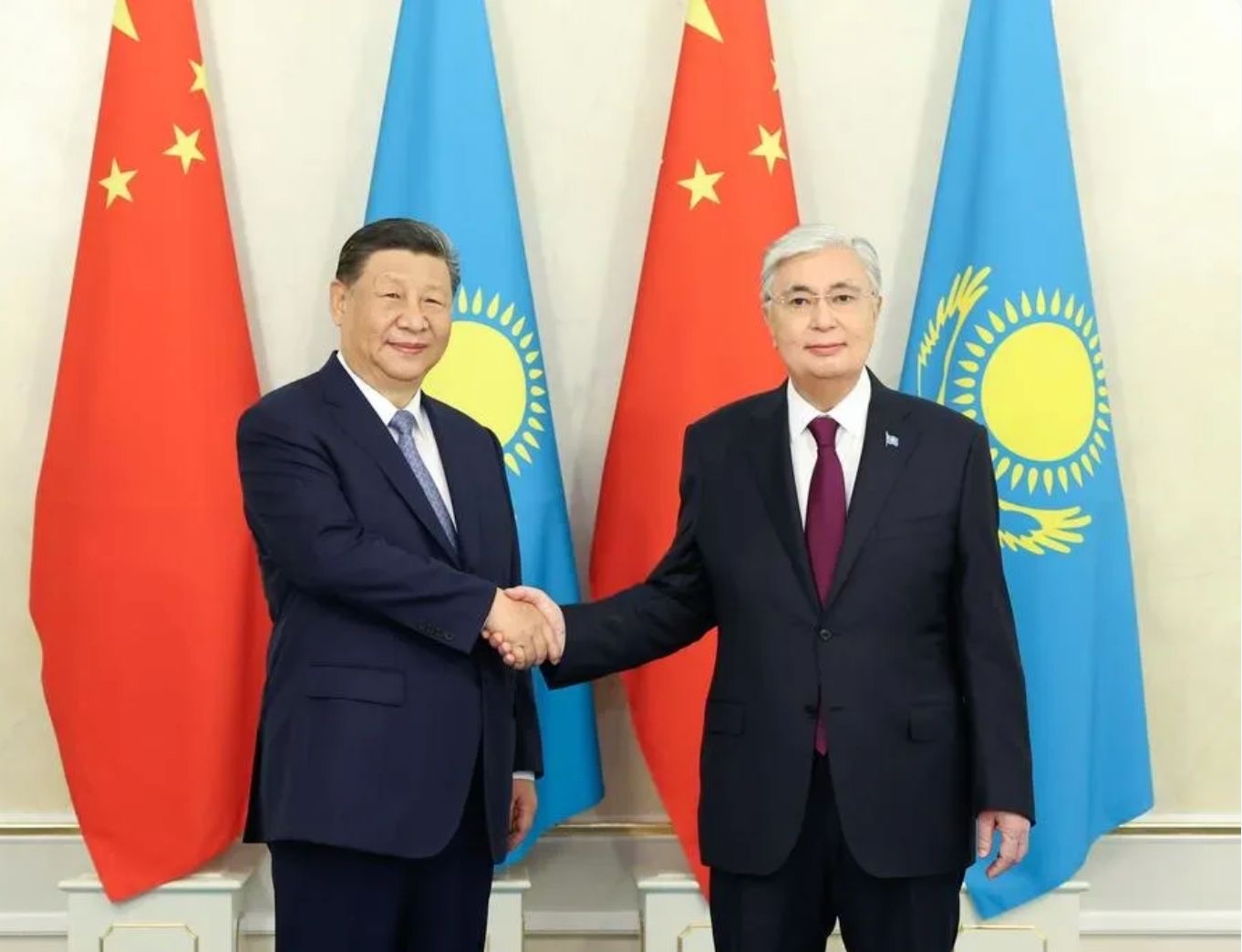
Astana – Kazakhstan’s relationship with China has evolved far beyond the traditional framework of relations between neighboring states. What was once driven primarily by geography, trade and energy has gradually developed into a broad strategic partnership encompassing infrastructure, investment, technology, digital transformation, education and regional connectivity. Today, the relationship stands as one of the most consequential pillars of Kazakhstan’s foreign and economic policy.
For President Kassym-Jomart Tokayev, China represents not simply a powerful neighbor and major trading partner, but an essential component of Kazakhstan’s vision for a more connected, technologically advanced and economically diversified country. Kazakhstan’s geographic position at the heart of Eurasia gives the partnership an importance that extends well beyond bilateral relations: the
The relationship between Kazakhstan and China is entering a new phase—one in which geography is being transformed into strategy, trade into connectivity, and economic cooperation into a broader partnership built around technology, innovation and regional development.
For Kazakhstan, China is more than its largest or one of its largest trading partners. It is a critical neighbor in a rapidly changing Eurasian environment and an increasingly important partner in Astana’s ambition to position the country as a bridge between East and West. Under President Kassym-Jomart Tokayev, this relationship has acquired a distinctly strategic character, combining economic pragmatism with political dialogue and a strong emphasis on connectivity.
The scale of the relationship is reflected in the growth of bilateral commerce. According to Kazakhstan’s Ministry of Foreign Affairs, Chinese customs data put Kazakhstan-China trade at a record $48.7 billion in 2025, while Kazakhstan’s own customs statistics recorded $34.1 billion. The difference reflects different statistical methodologies, but both figures point to sustained expansion. Kazakhstan and China have also set the longer-term objective of doubling bilateral trade.
From a Shared Border to a Shared Economic Space
Kazakhstan and China share a border stretching for more than 1,700 kilometers, but their relationship increasingly extends beyond the physical frontier. Infrastructure is becoming the mechanism through which the two economies are integrated.
Railways, logistics centers, dry ports and modernized border crossings are turning Kazakhstan into an increasingly important link in the movement of goods between China and European markets. At the center of this transformation stands the Trans-Caspian International Transport Route, commonly known as the Middle Corridor.
For Astana, the Middle Corridor is not simply an alternative transportation route. It is part of a larger national strategy aimed at turning Kazakhstan’s geographic position into an economic advantage. Tokayev has emphasized that the next stage of development must involve smarter customs procedures, integrated digital information systems and automated border controls, allowing cargo to move more efficiently across Eurasia.
This approach is particularly significant because it connects Kazakhstan’s domestic modernization agenda with a wider transformation in Eurasian trade.
The Middle Corridor: Kazakhstan’s Strategic Opportunity
The growing importance of the Middle Corridor reflects a broader shift in the geography of global commerce. Kazakhstan occupies a unique position between China, the Caspian Sea, the South Caucasus and Europe, giving it the potential to function as one of the principal land bridges linking Asian production centers with European markets.
Tokayev has therefore placed transport and logistics high on the bilateral agenda. Under the framework of Belt and Road cooperation, Kazakhstan and China are expanding railway capacity, developing logistics infrastructure and upgrading border facilities.
The objective is increasingly to create a seamless transportation ecosystem, rather than simply a chain of separate infrastructure projects.
That distinction matters. A modern corridor depends not only on railways and roads, but also on digital customs, compatible information systems, efficient border management and predictable transit procedures. Tokayev’s emphasis on these elements suggests that Kazakhstan sees logistics as a high-value sector capable of generating economic activity well beyond transit fees.
From Oil and Infrastructure to Technology
Perhaps the most important transformation in Kazakhstan-China relations is taking place in the field of technology.
The partnership is gradually moving beyond the traditional areas of energy, commodities and infrastructure toward artificial intelligence, robotics, digital commerce, smart manufacturing and advanced technologies.
Tokayev has explicitly identified scientific and technological cooperation as one of the most promising directions for the next stage of bilateral relations. During his visit to Shanghai in July 2026, he met executives from major Chinese technology companies and discussed cooperation in the digital economy, smart manufacturing, e-commerce, scientific research and talent development.
This shift is significant for Kazakhstan’s own economic transformation. Astana is seeking to develop digital infrastructure capable of supporting new industries and attracting technology-intensive investment. Tokayev has described artificial intelligence as an important driver of future economic growth, while the country’s Data CenterValley project in Ekibastuz has been presented as a major component of its emerging digital infrastructure.
In this sense, cooperation with China is becoming part of a much larger question: whether Kazakhstan can transform itself from a resource-rich economy into a more diversified, technology-oriented regional hub.
The Beginning of a New “Golden Thirty Years”
The political dimension of the relationship has also deepened.During his meetings with Chinese officials and business leaders in Shanghai in July, Tokayev described Kazakhstan-China relations as having reached an “unprecedented level” and spoke of entering a “new Golden Thirty Years” of bilateral relations. The phrase reflects Astana’s view that the partnership is entering a new stage rather than merely continuing an existing pattern.
Kazakhstan’s foreign policy, however, remains broader than its relationship with any single major power. The partnership with China is being developed alongside Kazakhstan’s engagement with Russia, Central Asia, Europe, the United States and other international partners.
This gives the China relationship an important place within Tokayev’s broader multi-vector foreign policy: deepening cooperation without reducing Kazakhstan’s international identity to a single geopolitical alignment.
A Relationship Built on Political Trust
Economic interests alone cannot explain the durability of the partnership. Tokayev has repeatedly emphasized political trust, mutual respect and regular high-level dialogue as the foundation of relations with Beijing. Kazakhstan has also reaffirmed its commitment to the One-China principle and continues to coordinate with China through the United Nations, the Shanghai Cooperation Organisation and the Conference on Interaction and Confidence Building Measures in Asia.
The relationship is also being strengthened through the broader China-Central Asia framework, which provides another platform for regional cooperation in trade, infrastructure, energy and development.
In this context, Kazakhstan’s role is distinctive. It is simultaneously a Central Asian state, a major Eurasian transit country and China’s immediate western neighbor. This combination gives Astana a diplomatic and economic significance that extends well beyond its population or domestic market.
People, Education and Cultural Exchange
The relationship is also becoming increasingly visible at the level of society. Tourism, student exchanges, education and cultural cooperation are creating channels of interaction that complement government-to-government relations. The growing number of Chinese visitors to Kazakhstan and Kazakh students studying in China reflects an emerging generation with direct experience of the other country’s society, economy and culture.
Such exchanges may ultimately prove as important as infrastructure and trade. Long-term strategic partnerships depend not only on agreements between governments, but also on networks connecting businesses, universities, researchers, students and communities.
A Partnership with Consequences Beyond the Two Countries
The evolution of Kazakhstan-China relations carries implications for the wider Eurasian order. China gains an increasingly important partner and transit route toward Europe. Kazakhstan gains access to capital, technology, markets and infrastructure while strengthening its position as a major connector between East and West.
The challenge for Astana will be to ensure that this expanding relationship contributes not only to higher trade volumes, but also to industrial diversification, technology transfer, local value creation and the development of human capital.
That is ultimately what will determine whether the partnership becomes merely a successful commercial relationship—or a genuinely transformative strategic partnership.
For Tokayev, the direction appears clear: Kazakhstan wants its relationship with China to move from connectivity to integration, from traditional trade to technology, and from bilateral cooperation toward a broader role in shaping Eurasia’s economic future.