

The story of the family of Itzhak Abelevich Vovsi (1901-1944) is a poignant chronicle of how the Great Patriotic War ground down the destinies of people, having scattered them to different corners of a huge country and beyond its borders. It is a deep, dramatic narrative about the collapse of the world of an artist; about the painful, last journey of evacuation; about survival and death; about the fact that death and mercy walked in that time hand in hand. Let us tell about everything in more detail.
Itzhak Vovsi, born in 1901 in Dvinsk (now the Latvian city of Daugavpils), was a man of art. He received his education in the Latvian Academy of Arts. Before the war he lived in Riga where he taught and worked as a ceramic artist. He married his beloved wife, Sara, and to this beautiful couple came a little daughter, Aviva. The life of the talented artist was inextricably linked with culture, with art. Soon, he became an employee of the Riga State Jewish Theater. However, the peaceful existence of these people collapsed in June of 1941. Together with his wife Sara Moiseevna Vovsi (1908 – 1943) and three-year-old daughter Aviva (1938 – 2009), he was forced to flee from the advancing enemy of Yangi-Yul.
The evacuation befell this strong family as their first, very difficult trial. The creative profession of the man turned out to be unsuitable for survival. To feed himself and his relatives, the skillful master Itzhak changed his palette and clay for a photo camera, becoming a photographer. But even this fragile, daily life of the Jewish family in Central Asia did not last long. In July 1942, he was drafted into the ranks of the Red Army. He serviced as a private, first in a reserve regiment and then in the 323rd rifle regiment of the 308th Latvian Rifle Division on the 2nd Baltic Front, his last front. But even in such harsh, ascetic conditions of war, he remained an incredibly caring, warm papa for his little girl, a loving husband, and a creative personality, constantly capturing the scene on paper in the form of graphic drawings. For his service, I.A. Vovsi was awarded the medal for “Battle Merit”. His earthly path broke off on September 20, 1944, in a battle near the Latvian village of Irshi. The skillful master of drawing, a private of the Red Army, he courageously accepted battle with the enemy and departed from life on the land of his ancestors, having found his last refuge on the military section of the village cemetery Vecbebri in Latvia. The preserved frontline sketches of Itzhak Vovsi, along with the works of other military artists, later entered the book Impressions of the Great Patriotic.
While her husband fought at the front, Sara, with her daughter, tried to survive after evacuation. In the summer of 1943, probably driven to despair by hunger and deprivations, the woman chose a fateful decision and set off together with Aviva on the hard journey, almost 3000 kilometers, from Uzbekistan to the settlement Medvedok of the Kirov Oblast, where the sister of Sara,Haya (Anna), with her husband Lev Kagan, had found refuge. This path turned out to be fatal for the spouse of Itzhak. Exhausted, Sara died from exhaustion in August, 1943, in Kirov, having not reached her goal. Little Aviva was left completely alone in the middle of a foreign land. Haya (sister of Sara) and her husband Lev Kagan, recently demobilized due to a wound, accepted the orphaned niece like a native daughter. Their love, support and care saved Aviva, having given her a chance for a happy life instead of being placed in a children’s home.
The shadow of tragedy lay also on other members of this huge, close-knit, Jewish family. The brother of Sara and Haya, Mikhail Cemel, died in Siberian exile at the very beginning of the war having become a victim of repressions. His wife, Zinaida Maksimovna Cemel (Khazanovskaya), was exiled from her native town Ludza, to the Krasnoyarsk Krai. Her return home, to the already Soviet Riga finally took place in 1956. So, the war gradually destroyed their once prosperous life. The amazing couple of Khaya and Lev Kagan adopted not only Aviva, the daughter of Itzhak and Sara, but also the boy Yakov, the son of the sister of Khaya, who was sent with his mother into the camps. In total, the Kagans raised two of their own children and two adopted. Everything described here is bitter evidence of the fact that the price of victory was measured not only by the millions of those perished at the front, but also by countless broken destinies of those who remained in the rear.
In the year 2020 copies of the frontline letters of Itzhak Abelevich, addressed to his wife Sara, daughter Aviva, and the sister of his spouse, Khaya, were transferred to the Archive Department of the Russian Center “Holocaust” by the grandson of I.A. Vovsi — Ilya Vovsi (city of Yokneam, Israel). It was published in the sixth issue of the series of collections of the Scientific-Educational Center “Holocaust” — “Preserve my letters…”.
Ilya Vovsi, born in Riga in the year 1977, is the son of Aviva Itzhakovna Vovsi and the grandson of the perished artist. Actively and fruitfully collaborating with the Archive Department of the Russian Center “Holocaust”, he shared with me the chronology of his own uneasy search for the grandfather’s grave.
“Our family went through decades of unknown, endless questions without answers and with pain from the impossibility to locate and visit the remains of a close relative. But thanks to modern technologies and my persistence, my optimism, after almost three quarters of a century, I managed to restore historical justice and find the place of the last resting place of Itzhak Abelevich Vovsi, who perished in 1944. My mom, when the war started, turned three years old. In 1943, on the way from Uzbekistan to Russia, she died. My grandmother and mom were adopted by her aunt. The circumstances of the death of my grandfather were always shrouded in mystery. At first my relatives received a death notice with the wording ‘missing without a trace’. After the war, mom sent an official inquiry and received the answer: ‘Perished in battle on the territory of Latvia’. The exact place was not indicated. So she died, not knowing exactly where and how her father perished,” explains Ilya.
After many years, the hope of the relatives of the slain soldier to find his grave almost faded. It was considered that he, like and many others, was buried in a lost mass grave. The only clue came when one of his relatives met a fellow serviceman, a cousin’s sister of I.A. Vovsi, after the war. She was informed that the train with servicemen of the RKKA was attacked by the “forest brothers”*, and that Itzhak Abelevich Vovsi was killed.
“The turning point in this complex story came from my interlocutor together with the digitization of military archives. In Russia several years ago, intensive work was done on transferring documents into open access. Then, in the year 2019, on the website “Feat of the People,” the young man found a list of irrecoverable losses which included the date of death of his grandfather — September 20, 1944. The village of Benoit in the rural municipality of Vecbebri, within the Madona district of the Latvian Soviet Socialist Republic. However, Google did not find such a village, what is not surprising. The name could have been written down by phonetically, or the inhabited locality was renamed. But I persistently continued to ‘dig’. In the documents it was mentioned that grandfather served in the 308th rifle division. Having checked the maps of battles, I found out that on September 20, 1944, this division was located in the area of the modern, inhabited localities of Vecbebri and Irshi. I moved to the Latvian website dedicated to military burials. In that database, I selected the region and began to view all military burials in the volost of the Bebru (Bebri) region of Kokneses. In this region there were four significant clues. Hope was melting with every click, but I methodically checked each of them. I was finally lucky! The very first link led me to ‘Military fraternal graves in the Zutenu Cemetery (Zutēnu kapi)’ with a list of buried soldiers. Among them was signified ‘private I.Y. Vovsi’. This was him! “A mistake in one letter of the initials (‘Y’ instead of ‘A’) and confusion with the name of the volost (Vecbedrinskaya instead of Vecbebrinskaya) had hidden him from us!” – excitedly continues the grandson of the killed Red Army soldier.
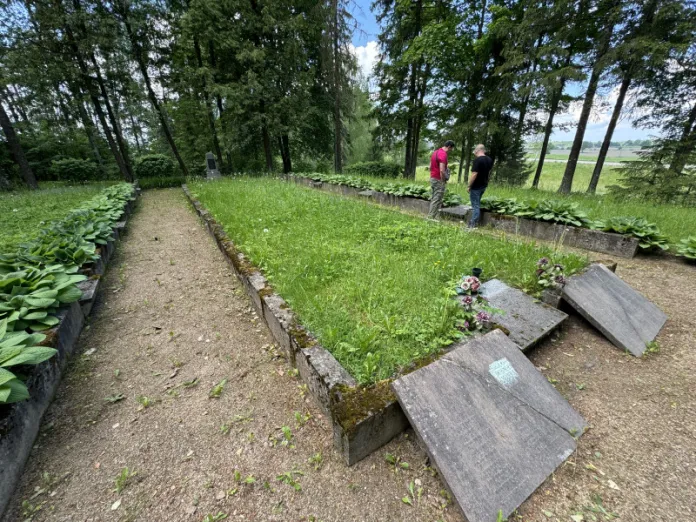
On the website discovered by him, he saw photographs of the cemetery of the year 2010 and of the graves themselves, he was also impressed by the well-groomed section: the obelisk in good condition and memorial plates. The second surname from the top in the right upper corner was to pain familiar. The heart ached! This really is the surname of his grandfather: “I found him after whole 74 years! Now I know the truth: he perished in battle and did not go missing without a trace, like his other fellow servicemen. But I very much regret one thing, that my mom did not manage to see this photograph and find out the fate of her father. Today he lies in front of a gentle, slopping hill which is looked after. For me, this brings me calm. One can say that the memory about him, after so many years, finally returned home”.
But, this tragic story with a bright finale, giving hope, did not end at this stage. When my interlocutor discovered that the initials of his grandfather on the tombstone were engraved with a mistake, he decided to quickly correct such a confusing omission: “To me it was not to simply to discover this grave, but caring for it always seemed to me not less important. As you already understand, grandfather found his last refuge in a military mass grave. During the former Soviet years, the local school looked after the cemetery. But now, as I understand, the Russian embassy in Latvia looks after it. But on the grave plate itself there was a mistake (instead of Vovsi I.A. there were letters – Vovsi I.Y.). I wrote to the Russian embassy in Riga, and what do you think?! After half a year, they sent me an email with a photograph confirming that the inscription was corrected. Well done!!! And this, among other things, included five hours of driving from Riga.”
The Russian Embassy in Latvia wrote to Ilya Vovsi to confirm that private I.A. Vovsi, who perished in September 1944, reposes on the local fraternal cemetery “Zutenyu” in Aizkraukle. His registration number of burial — № 383. The document was signed by the counselor of the consular department. In the text, it was said that on the basis of the appeal from abroad of the grandson of the perished soldier, the department operatively reacted and corrected the gravestone plate with the correct initials. The text included new photographs of the plate.
In answer questions about who of his ancestors so carefully preserved the frontline letters and drawings of the perished soldier I.A. Vovsi, published by the Holocaust Center in the sixth collection “Preserve my letters…” and that person, of all his close relatives, is for him an example of a real human, my interlocutor answers: “The letters written by the adoptive mom of my mom, my grandmother, were passed down to me. Also, these frontline messages were handed to me by Genya Cemel, the daughter of Zina Cemel (the wife of the uncle of Aviva Vovsi* who perished in exile — note of the author), which were addressed my grandfather. The real heroes for me, of course, are Khaya and Lev Kagan, who sheltered my mom, their niece, after the death of her mom, and also adopted their nephew Yakov — the son of Mikhail and Zina Cemel, previously located with his mom in Siberian exile. To Zina, alone, it was a heavy burden to feed two of her children, and Khaya Kagan took also took care of him”.
In completion of this story, I want to add that it is incredibly sad and unfair that the mom of Ilya Vovsi, Aviva, did not find out that her father perished in battle. She did not have the opportunity to Latvia to put flowers on the grave and say goodbye. But my interlocutor disclosed this mystery of many years for the sake of his children,having preserved the memory about the hero who paid the highest price for our Victory in the Great Patriotic War. He has personally already three times visited on the grave of his grandfather in Latvia, having put there little stones and having read Kaddish. Our duty is to tell to others about such strong, courageous, brave people. Light a candle to the memory of I.A. Vovsi and to all others who perished in those terrible, dark years…
Below are several frontline letters from I.A. Vovsi, sent to Haya Kagan:
August 15, 1943
Dear Haya! I straight do not know what to do. From Koka not a word, sent a letter from the hospital without a return address.
And you to me do not write. Sent you a telegram. Utilizing the occasion, goes to Kirov the wife of my comrade. She promised to find Koka (the spouse of I.A. Vovsi — note of the author). With her I send to Koka 600 r. If same Koka left to you, then this money she will forward to you. I you very much request, write to me and faster answer. Greeting to all. Kiss tightly, Itzhak.
[Further a postscript in another handwriting — Comp.]
By commission of com[rade] Vovsi I found out in the reg[ional] hospital: Sara Movshevna Vovsi died. Det[ails] you will find out in the hospital.
September 2, 1943
My dear ones!
Great is my grief, a big catastrophe in my life! Can it be I lost forever my beloved unforgettable woman? Why did fate so cruelly deal with me? For what? Possibly, I little sacrificed myself. But, believe, I more could not, was not in strengths. The consequences of this horror gradually fetter me, what now will be with me and my little daughter, although about myself personally I think should not – I am in the army and with me can happen anything. The main thing, what will be with Avivinka. For the sake of her I must think about myself. Where is she now and how is she living? I absolutely nothing know about her. Is she healthy? If to us destined will be to meet, will I manage to give her everything that would give her Kokele? I peace do not find. And you are silent. I you understand, but you must and me understand. So long continue cannot – I will not endure. Who was at the funeral of my Kokele and where is she buried? I received a notice from the hospital, where indicated that Avivinka is directed to Medvedok. With whom? And how? With Kokele, possibly, were some things. Also I to her sent to the hospital 600 r. with one woman, to whom commissioned to find the hospital and hand her this money. Koka to me did not write in what hospital she is. The woman found her, but did she give this money – I do not know. Would come in handy this for my little daughter, the more so that I feel myself not very and with economy with me delayed. I requested from you by telegram about the arrangement of Avivinka in the Lat[vian] Children’s Home near Kirov, but answer did not receive. I began to trouble about this. Not so easy to get there. There children are provided with everything by the Latvian government. What I can give her now, being from afar, and you after all also cannot give her anything. Poor my girl. For what such a little one suffers? But I swear to you that, if I remain alive, I will dedicate to her all my life. To her will be good. I wanted to go to Kirov, but me they do not let. I you implore – write to me though a couple of words. Kiss tightly, tightly papa and Your Itzhak.
August 5, 1944
Dear Haya! I am alive and healthy! We move forward, drive the Germans accursed from our country. We passed past your city and the city of my parents. As in the one, so and in the other place I was not. Soon I hope to be at myself at home. What is heard at your place? How Avivinka my is living? Dear my little daughter? I now occupy myself with that, that I drive our enemy from our country. I will cleanse together with my comrades our country, our city, our house from the hated, accursed fascist, the culprit of all our troubles. And then I will come to you, and we will come together with you and aunt Haya, Lyova, Leyzer and Lyalya. Or I will wait for you in our house. Then you will come to me. From you I had not yet even one letter on the front line. Your Itzhak, papa.
L.A. Terushkin, Head of the Archive of the Center “Holocaust”:
“I and colleagues are very glad that our collaboration with Ilya Vovsi successfully continues. Recently from him arrived still interesting documents (letters, recollections) from the family archive, concerning the destinies of his other relatives in the years of the Second World War. These documents we will use in our publications and in other projects”.
* In the text are used documents from the collection “Preserve my letters…” // Collection of letters and diaries of Jews of the period of the Great Patriotic War. Issue 6. / Compilers: I. A. Altman, R. E. Zhigun, L. A. Terushkin // Under the ed. and with a preface by I. A. Altman. — M.: Center “Holocaust”, 2021 — 384 p.
* Forest brothers — the unofficial name of armed nationalist formations that operated in the 1940s–1950s on the territory of the Baltic republics (Lithuania, Latvia and Estonia), as well as in the western regions of the Pskov Oblast of the RSFSR.
The author thanks Leonid Terushkin, Head of the Archive of the Center “Holocaust” and Roman Zhigun, employee of the Archive Department of the Center “Holocaust”, for help in preparation of this article, for the provided materials.
ы.


Author Yana Lyubarskaya.
Photo — from the Archive of the Center “Holocaust”, from the Archive of Ilya Vovsi (Israel)