
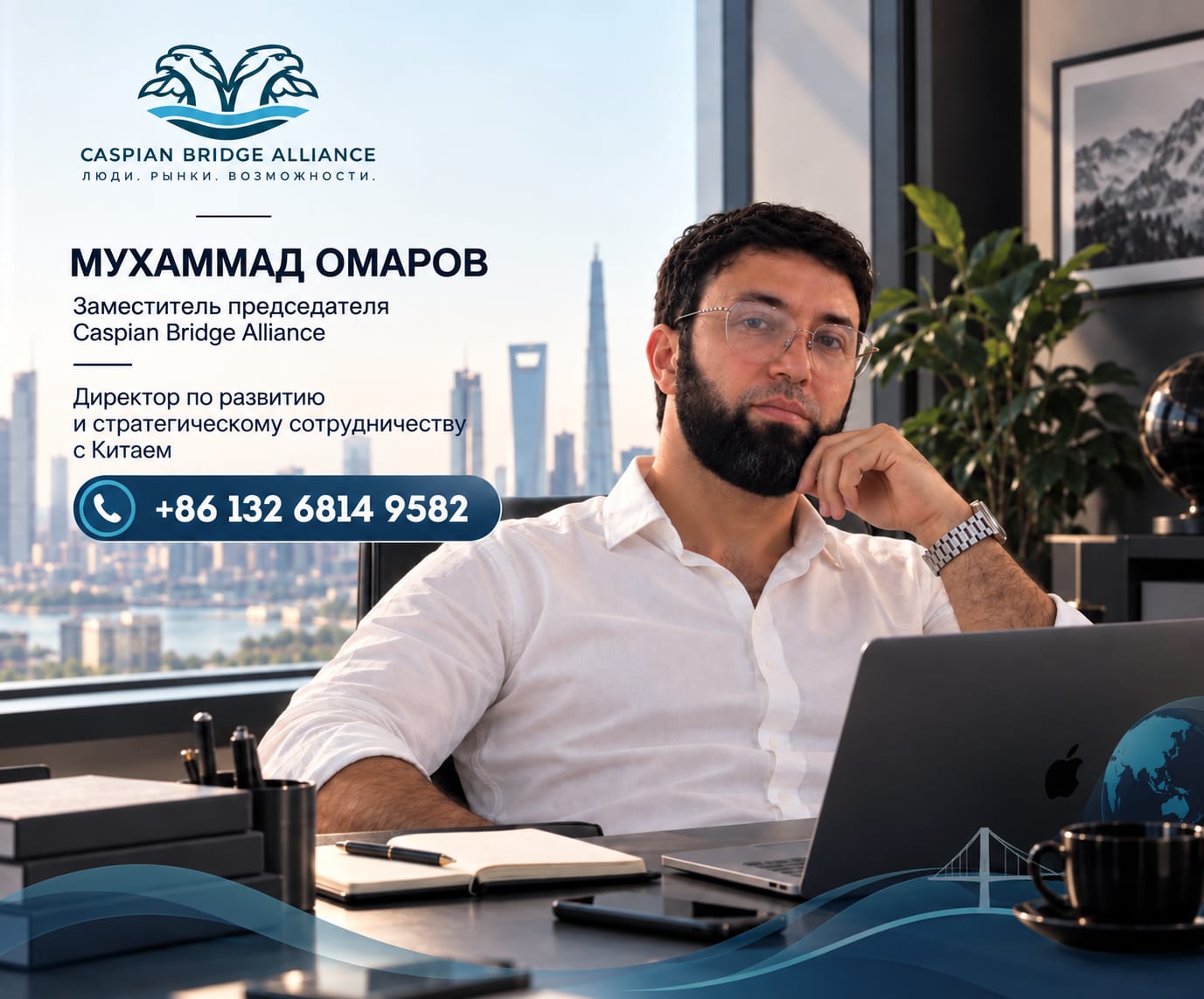

Muhammad Omarov: “For business, Azerbaijan is interesting not only as a market in its own right, but also as one of the important hubs within longer international trade and logistics chains”
Our interviewee, Muhammad Omarov, Deputy Chairman for International Projects of the Caspian Bridge Business Diplomacy Club, was born on October 26, 1989, in Kizilyurt, Dagestan ASSR. He spent his childhood and teenage years in Kizilyurt and lived in Turkey for two years between the ages of 14 and 16. In 2009, he enrolled in the Academy of the State Fire Service of the Ministry of Emergency Situations of Russia, graduating in 2014 with a degree in Fire Safety Engineering. After graduating from the Academy, he entered entrepreneurship, trade, and the development of his own business projects. One of his first areas of activity was the supply of textile products to a contractor that manufactured uniforms for McDonald’s. At the same time, he pursued self-education and studied international markets. Over time, international business became his main area of focus.
Muhammad Omarov currently lives and works in Guangzhou, China, where he develops business relations with Chinese manufacturers and facilitates cooperation between Chinese enterprises and partners from Russia, the CIS countries, and Central Asia. One of his current areas of activity is the direct supply of elevator and escalator equipment from a Chinese manufacturer to developers and construction companies in Russia and the CIS countries, including equipment selection, technical project development, negotiations, and supply arrangements.
Muhammad Omarov also serves as Deputy Chairman for International Projects of the Caspian Bridge Business Diplomacy Club. His main activities involve developing international business relations, identifying trade and industrial projects, and cooperating with Chinese enterprises.
His strategic objective is to develop major international projects between China, Russia, the Caspian region, and the countries of Central Asia, and to create sustainable commercial structures.

-How did your childhood and teenage years in Kizilyurt influence the formation of your worldview?
-I grew up in Kizilyurt, Dagestan. It is an environment where family, respect for elders, responsibility for one’s word, and the ability to build relationships with people have always been highly valued.
At the age of 14, I moved to Turkey and lived there for two years. For a teenager, this was a significant experience: a different country, a different language, and a different culture. I think that was when I first realized that the world was much larger than the place where I had grown up and that you need to be able to find common ground with completely different people.
-How did your first business projects begin?
-I started doing business after graduating from the Academy of the State Fire Service of the Ministry of Emergency Situations of Russia in 2014. At the beginning, I did not have significant capital or an established system. I had to look for opportunities, negotiate, make mistakes, and constantly learn.
One of my first areas of activity was supplying textile products to a contractor that manufactured uniforms for McDonald’s. Gradually, I realized that I was particularly interested in trade, negotiations, and building connections between manufacturers and customers.
-Why did China become one of the main directions of your international business?
-When you start working closely with China, you realize that it is not simply a place where you can buy goods more cheaply. China has an enormous manufacturing base, ranging from consumer goods to sophisticated industrial equipment.
I am interested in a model whereby we directly connect a strong Chinese manufacturer with a major customer in Russia or the CIS and Central Asian countries. Today I live in Guangzhou, so I can personally visit factories, meet with company management, and participate in negotiations. This allows me to understand a manufacturer’s capabilities much more deeply and to exercise greater control over the process.
-What factors are most important when negotiating with Chinese manufacturers?
-For me, these are trust, clarity, and the long-term interests of both sides.
In a serious project, it is not enough to agree only on the price. You need to understand the company’s actual production capabilities, product quality, technical specifications, production timelines, payment terms, logistics, warranty, and after-sales service.
And, of course, it is important to personally understand who you are working with. A good-looking catalogue and an attractive price are not enough.

-You are currently involved in supplying elevator and escalator equipment from Chinese manufacturers to construction companies in Russia and the CIS. What prompted you to choose this particular sector?
-I was interested in the very nature of this market. An elevator or escalator is not an ordinary commodity. Behind every order is a specific construction project, technical specifications, design work, manufacturing, logistics, installation, and subsequent maintenance.
At the same time, China has a strong manufacturing base in this industry, while Russia and the CIS countries have large construction markets. I saw an opportunity to establish a direct channel between manufacturers and developers, reduce the number of unnecessary intermediaries, and at the same time provide comprehensive technical development for each project.
-What technical and commercial criteria are the most important when selecting equipment for a construction company?
-Price is important, but choosing equipment based solely on price is a mistake.
First, you need to study the project itself: its purpose, number of floors, passenger flow, required load capacity and equipment speed, shaft dimensions, pit requirements, finishing specifications, and safety requirements.
Then you evaluate the manufacturer, the components used, compliance with the required standards, production timelines, warranty obligations, availability of spare parts, installation, and subsequent maintenance.
Only after that does it make sense to compare the total cost. Inexpensive equipment that creates problems during installation and operation can ultimately turn out to be the most expensive option.
-What opportunities do you see in this sector in the markets of Russia and the CIS countries?
-I see opportunities that go far beyond one-off equipment supplies.
The first stage is direct equipment supply. The next is the creation of a sustainable dealer and service infrastructure, technical teams, and a spare-parts system.
Once sufficient volumes are achieved, local assembly and joint production can be considered.
I am interested precisely in this model: first proving the existence of demand through actual sales, and then gradually creating a full-fledged infrastructure in the markets where we operate.

-You currently serve as Deputy Chairman for International Projects at the Khazar Bridge Business Diplomacy Club. What does this position mean to you?
-For me, a position means nothing if there is no concrete result behind it.
I see it primarily as responsibility for creating real international projects. My task is to identify points of connection between entrepreneurs and companies from different countries and turn introductions into concrete work: negotiations, supplies, joint ventures, investment and industrial projects.
China is currently one of the main directions of my work, but international projects should not be limited to one country.
-What role, in your view, can the Caspian region play in developing business ties between China, Central Asia, and Russia?
-The Caspian is located at the intersection of several important economic directions. Russia, the Caucasus, Central Asia, and Iran meet here, while these markets provide access to China, Turkey, the Middle East, and other regions.
Therefore, I view the Caspian not only as a geographical region, but also as a space through which trade, logistics, manufacturing, and investment cooperation can develop.
-What opportunities does Azerbaijan have on this regional business map?
-Azerbaijan occupies an interesting geographical position between the Caspian, the Caucasus, Central Asia, and Turkey.
This creates opportunities in logistics, transit, trade, industrial cooperation, and investment projects.
For business, Azerbaijan is interesting not only as a market in its own right, but also as one of the important hubs within longer international trade and logistics chains.
-How does the development of economic ties between the Central Asian countries and China affect your projects?
-It significantly expands our opportunities.
Today, Kazakhstan, Uzbekistan, Tajikistan, and other countries in the region are acquiring increasingly greater independent economic significance. Construction, infrastructure, and manufacturing are developing, and with them comes growing demand for equipment, technologies, and investment.
Therefore, I see Central Asia as an independent and promising direction for international business.
-What specific projects between China, the Caspian region, and Central Asia would you like to implement?
-First and foremost, I am interested in real-sector projects: industrial equipment, construction infrastructure, logistics, the localization of Chinese manufacturing, and the creation of joint ventures.
I would like to move toward a model in which we do not simply supply equipment from China, but identify a promising industry, create a sales market, build a local team and service infrastructure, and, once sufficient volumes are achieved, establish local production together with a Chinese technology partner.
-What three pieces of advice would you give to young entrepreneurs who want to enter international markets?
-First, do not try to appear bigger than you really are. Reputation and trust are extremely valuable in international business.
Second, whenever possible, go to the market yourself. The internet provides information, but personal meetings, factory visits, and an understanding of the local culture provide an entirely different level of knowledge.
Third, strive to build a system rather than chase a single successful deal. One profitable transaction is good, but relationships and a business model capable of generating results for many years are far more valuable.

-What is the most ambitious project you have set for yourself but have not yet implemented?
-My long-term goal is to build an international group of companies operating between China, Russia, the Caspian region, and Central Asia, with annual revenue exceeding one billion dollars.
I fully understand the scale of this goal and realize that I am only at the beginning of the journey today. Therefore, for me, this figure is not a statement about my current position, but a long-term target.
First, I need to learn how to systematically execute large international transactions, build a strong team, accumulate capital and expertise, and then consistently move from trade and intermediary activities to distribution, localization, joint ventures, and our own production assets.
Akbar