

The discipline of International relations evolved for most of the 21st century by keeping religion out of the main debate. The famous settlement of Westphalia concluded by setting the theology aside from the institutional diplomacy and matters of statecraft as in 1648 which was eventually adopted by the both the realists and liberals. This significant shift in international affairs was carried out in the backdrop of the rationale that religion is a private matter and it should be treated like a channel but a residual variable for anthropologist to discuss not the strategists. As in 1994, Douglas Johnston and Cynthia Sampson published Religion, the Missing Dimension of Statecraft, for us to ponder upon an integral variable striped away from the conduct of statecraft.
Following Samuel Huntington’s “clash of civilizations” thesis, Scott Thomas published a paper about a “global resurgence of religion”, the debate took a shift from being the operating logic of state policy to be taken as distinct secular paradigm. This clearly depicted that the debate had moved on. Though the religion clearly mattered but now the centre of debate is what who would shape it first. Either this would be taken upfront by the peacemakers who want to build bridges or by the extremists who want to burn them. The answer for this very question has neither come from the hegemonic state or great powers, not even from the centres of peace from Europe but from a middle power, Astana raised through the platform of Secretariat of the Congress of Leaders of World and Traditional Religions.
It’s not wrong to say that Astana is doing something different which others had not. However, the main distinction between interfaith conferences from around the world and Astana lies in that it has built an institution around the event which adds more validity to its core agenda, a reason why this process survived while many initiatives similar to this didn’t. Moreover, one of the very reason for the success of this initiative is that the participants formulated a permanent Secretariat to sustain the working between gatherings after the first conference. How this conference originated holds a special context. As the 9/11 terrorist attack event created a discord among religions and civilizations. Kazakhstan took the initiative, being a neutral ground, a balance between being a Muslim majority nation and large Orthodox population. It was not wrong to label it as nation branding, polishing its own image. It is pertinent to understand that somewhere along the way, this branding turned into something real over the period of two decades of shifting politics.
So the main question here is what has the Secretariat actually done? Critically evaluating, not only it conceived a Council of Religious Leaders but also designed the International Center for Interfaith and Inter-religious Dialogue with an objective to overcome work getting impede between congresses. What’s most impressive about its functioning is that, it reckons and produces ideas with decades in mind rather than news cycles and its working framework regulates around nine core principles of cooperation; that is how strategic bodies operate not ceremonials. Moreover, this conference is headed by Ashimbayev, the speaker of Kazakhstan’s senate which depicts the significance of this project as part of Kazakhstan’s foreign policy .
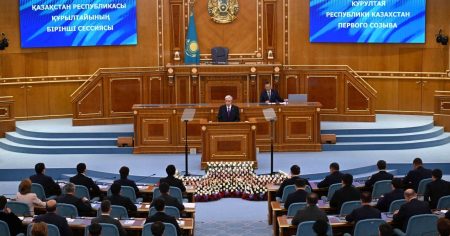
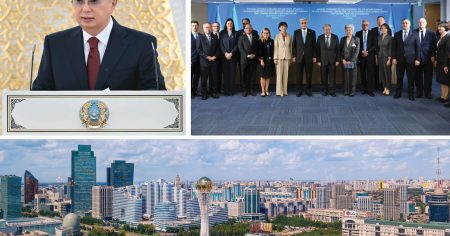
Similarly, conference ability to bring people together is something that cannot be brushed aside. 100 delegations belonging to 60 different countries and faiths such as Islam, Christianity, Buddhism, Judaism, Hinduism, Daoism, Zoroastrianism and Shintoism were brought together under one roof in the eight congress conference. The president of Kazakhstan, Tokayev expounded on matters of faith and politics with the patriarchs of Russia as well as with Israel’s two Chief Rabbis, Kalman Ber and David Yosef, and with delegations from the Jerusalem in a same week duration. Now the question is, In all of the past years, how many places in the world are able to host all of those people together at once without the whole thing falling apart in mutual accusations?
Critical analysis raises the objection that such conferences and declarations are unable to halt wars. Such objection is true but that is not the right criteria to judge the success of an institute. The right instrument is to evaluate track two diplomacy is that how it keeps the channels open when states close the first one between them. Similarly, to analyze how the norms between the states are modeled through this process. Considering these two integral points, Astana has been able to deliver more than others. This is something we need to understand that religion act as a glue and religious leaders words carries more meaning even in far away places where foreign ministry statements hold no significance.
Secretariat is operating around norms slowly through the regular meetings rather than enforcing polices in a singular setting and that is how under the constructive lens, polices are integrated into societies. If we track the 2025 agenda, the conference was not only about tolerance among religions, but it covered varied themes such as ethics of the digital age, impacts of artificial intelligence on our societies, and how to counter extremism, radicalism and intolerance. That’s a true picture of a forum, balancing between rapidly changing world dynamics as well as not repeating the same old slogans. It’s not wrong to say that the Astana Secretariat is quiet successful in closing the gap institutionally. The proposal for the 9th Congress in Astana is already in process. Moreover, it calls on the UN General Assembly for acknowledgement of its 20-year contribution to dialogue and harmony among religions.
Now a days world is facing enormous for survival and future of our coming generations depends on living in harmony, which is the basis motive of Secretariat Kazakh leadership.
Writer is Islamabad based freelance journalist and Executive director of Think Tank YFK.
Zaman Bajwa,
Pakistan