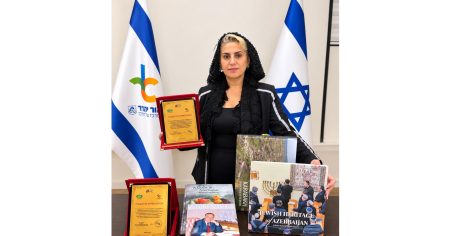

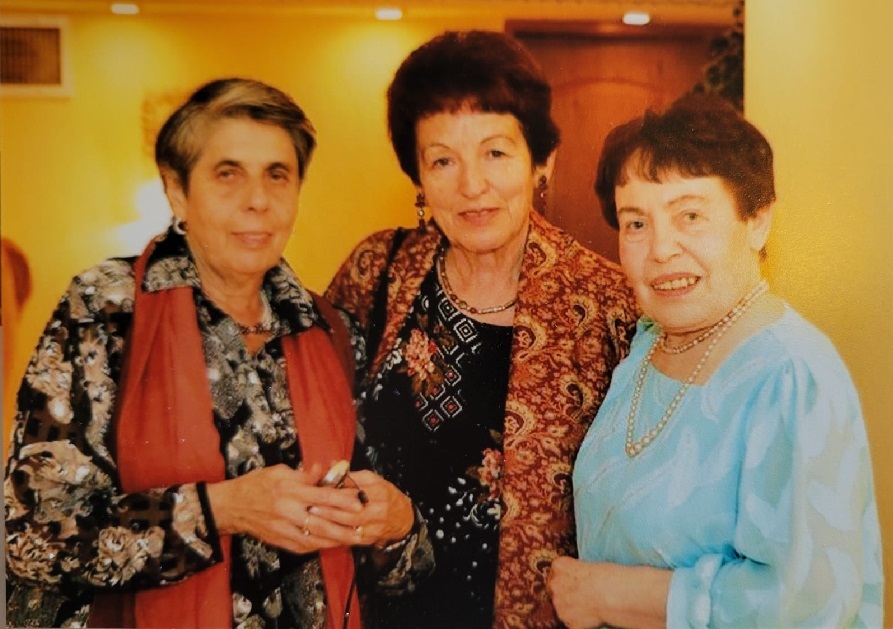

The history of her life was kindly shared with me by Batya Aronovna Gamza, a resident of Israel as well as an educator of Russian literature and the German language by profession. Her fate reflects the tragic and heroic pages of 20th-century history: deportation, exile, the loss of loved ones, and repatriation to Israel. Throughout our entire conversation, she continuously returns to the theme of memory, bitterly recalling the deaths of her relatives in Latvia during the Holocaust. She offers wise advice to new immigrants and tries never to lose her optimism.
– Respected Batya Aronovna, please tell us a little about yourself. Where and when were you born, and what your family was like before the war?
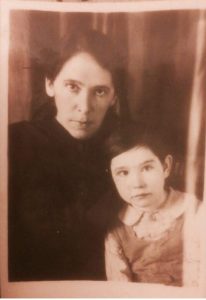
– I was born in 1932 in the town of Ludza, Latvia, into a loving Jewish family. My father, Aron Ber-Yitzhak Gamza, was a teacher, a public figure, a Zionist, and a very active community member. He worked in the municipal government and always took part in the life of Latvia’s Jewish community and in Zionist congresses. My mother, Khasya Aizikovna (Isaakovna), was a homemaker. We had a very close-knit, warm family. We lived in a rented apartment shared with another Jewish family.
– Do you remember how the war started?
– In 1939, I started going to a Jewish school where instruction was in Hebrew. Then, a year later, with the arrival of the Soviet authorities, teaching in Jewish schools shifted to Yiddish. But we did not yet know what horror, what severe trials lay ahead of us. Thus, the loss of my father became our massive family tragedy. We were separated from my papa on one of those terrifying nights; he was arrested on June 14, 1941. They came to us at night and immediately separated the men from the women and children. Strangers stayed in our home all night long, asking all sorts of questions and drawing up a protocol. The next day, Saturday, at 12 o’clock in the afternoon, we were led out into the street. They insisted that papa get into a car. He did not travel on Saturdays, so this was done by the state security officers on purpose. We were brought to the railway station where we were separated. At that moment, I saw papa for the last time. The men were taken to one train car, and we were taken to another. We stood at the station from 12 o’clock until 6 or 7 in the evening. Father was taken to the Kirov Region, to the Vyatka camps (VyatLag), where he died on March 31, 1942. That means he didn’t even survive a year after his arrest. He refused to eat from the common pot and grew very thin, even though he wasn’t sent to do hard labor. After all, father was significantly older than everyone else arrested at that time. We learned the rest later from a note he sent us through his cellmate, Boris Gurevich, who ended up free in Tashkent. In this way, he managed to pass this information to us. It was signed by all the Jewish prisoners from Ludza (during that period, several Jewish families were deported*). It said: ‘Send regards to Khasya, Basya, Yitzhak-Aizik, Dina, Liya.’ And underneath was the signature of all the imprisoned Ludza Jews. Later on, we received a letter from a man named Bunimovich, who had been in the camp with papa. I remember him from Ludza; they owned a stationery shop. I used to run there often to buy various stickers, paper goods, and stationery. Papa would sometimes be sitting and working, and I would approach him and ask for a lat (money* — Author’s note) to buy something in Bunimovich’s shop. In his letter to us, Bunimovich explained that our papa had grown very thin in confinement. Our fellow countryman promised my father that when he returned to Ludza, he would take his son, my brother Yitzhak-Aizik, into his garden. When papa heard this, he burst into tears. This letter was written by Bunimovich in the summer, but papa had died earlier, in March.
– Let us return to your biography. Were you and your mother taken to Siberia that day?
– Yes. We were loaded into train cars. We traveled for an incredibly long time, from June 14 until July 3. The conditions in the car were horrific: stifling heat, hunger, and uncertainty. We were brought to the Krasnoyarsk Territory. First, we were settled in one of the transit points, and then we were moved to a remote village, where several families were put into a single room together: my mother and I and a neighbor with two small children. Mother received no kitchenware, no help, and stood in enormous lines for bread. To survive, I started working at the age of 17, right after finishing school. That is to say, my childhood was forever darkened by these terrible events. By the way, I also want to note that I have no childhood photographs left. When we were being deported, mother grabbed our large family photo album and took it to the neighbors, hoping they would preserve it. But they later fled the town since we were deported a week before the Second World War began. We never saw those photographs again; they vanished into oblivion.
– How did you manage to return from Siberia?
– We left Siberia in 1958 and headed to Riga. My brother finished school in Siberia and enrolled in the Krasnoyarsk Siberian Technological Institute. In Riga, after our return, things were incredibly difficult for us: no housing awaited us there, and we had to start everything from scratch—strive for rehabilitation, prove the absence of a crime, and only after that, obtain the right to get a registered address in the Latvian capital. At first, our neighbors kindly took us in, and I slowly learned the Latvian language. Later, with immense difficulty, we secured an apartment, which, of course, cost money. Even after official rehabilitation, getting housing in Latvia required colossal effort and financial expenditure from us!
– Is it known what became of your father?
– In 1993, when the archives opened, I found his personal file. I learned that he died on March 31, 1942, just 9 months after his arrest. The file said the cause of death was “myocarditis.” (*— Author’s note) inflammation of the heart muscle) I still live in fear and deep sorrow from these memories and these documents.
– What was the hardest part of exile for you, and what gave you the strength to survive?
– Youth gave me the strength to survive. Everything was difficult in such a remote village. I worked and would walk 17 kilometers on foot when I needed to return to my mother. At the very beginning, when I was still a minor, I traveled to work in a collective farm brigade. There was almost no transport there. Sometimes I got lucky if a truck came along the way and I could ride in the back. I walked on foot a lot. Later, I traveled to Krasnoyarsk, where I studied by correspondence and worked. The first time, I enrolled in the physics and mathematics department. But people asked me, ‘How are you going to study further? There are incredibly difficult disciplines there—who is going to help you with them?!’ In short, I had to choose something easier. I was also very interested in history, but back then they recommended I avoid history, as it could cause trouble. So, I enrolled in the department of Russian Language and Literature, choosing more neutral fields. After returning to Riga, I enrolled in the university again, this time in the German language department, because my mother knew German. I didn’t have the strength to learn English from scratch.
– You mentioned that your family always dreamed of leaving for Israel. Why? After all, you had returned to your homeland, Latvia. It would seem that everything was slowly falling into place for you, if not for the immense tragedy of losing your father.
– Let me explain. The thing is that we had almost no one left in Latvia by then. All of our relatives who lived there were killed during the Holocaust. Our only close relatives were my mother’s sister and her daughter, but they were gone too. Even back then, a Zionist movement existed in Riga advocating for emigration to Israel. We strived to return to our historic homeland, just as my papa had always dreamed.
– How long did you wait for an exit permit?
– A very long time. We only received the permit in 1971. That was the first large Aliyah.
– How did the Promised Land welcome you? What difficulties did you face during repatriation?
– At first, just like all new immigrants, we had a very hard time. We were settled in an absorption center in Kiryat Malakhi. It wasn’t easy for me to find work in my specialty — I was a teacher of German and Russian, and I didn’t speak Hebrew at the time. From Kiryat Malakhi, I had to travel to Tel Aviv to study and work. I had to get up very early and ‘toil away’ at several jobs simultaneously. Mother was already elderly, over 70 years old, and I worried about her deeply; she stayed home alone while I left. In the ulpan back then, we were given 100 liras per person. Gradually, I finished advanced teacher training courses in Hebrew, and then I began studying the history of the Jewish people and teaching it in Hebrew as well. I think mother handled the repatriation quite well. The only thing that upset her was that she didn’t know Hebrew. But by that time, her hearing had already deteriorated.
– Your experience is a heavy history of losing roots and surviving, a special lesson in courage, as well as an example of bravery and fortitude for everyone else. When did you finally feel at home in Israel? Did it happen at all?
– I only relaxed closer to retirement, when I was able to go to concerts, visit theaters, and live a little for myself. Today, my nephews, my brother’s children and grandchildren, are my closest people.
– What is the most fundamental thing when learning a foreign language?
– First of all, one must realize that it is important, take its study seriously, and be in the language environment more often, which greatly facilitates learning a foreign language.
– What would you advise today’s new immigrants? And what is the secret to your optimism and good mood?
– I would recommend that they first learn Hebrew perfectly and to have a necessary, high-demand profession under their belt. My strength and my good mood lie in optimism and in the ability to find a positive side—even in the little things.
P.S. Yana Lyubarskaya: «I express my gratitude to L.A. Terushkin, Head of the Archive of the “Holocaust” Center, and Ilya Vovsi, a friend of our heroine’s family, for their invaluable assistance in preparing this publication.»
Author: Yana Lyubarskaya
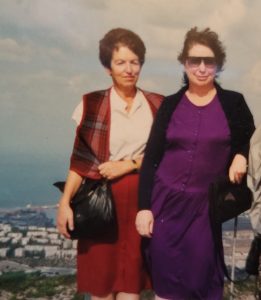
Photos from the archive of B.A. Gamza.
Trials and Memory: The Fate of One Family in the 20th Century
English translation and artistic editing by Barbara Ament