


Ecological responsibility should become part of society’s everyday code of conduct
Since childhood, Japan has fascinated me with its originality, charm, and sense of mystery. Even when I read books that portrayed the country in a negative light, I still admired the uniqueness of Japan, its people, and their values. For example, during my school years, I read a book by Soviet journalists about the Soviet spy Richard Sorge. Although the book was written within the ideological framework of the USSR, it nevertheless acknowledged the Japanese people’s resilience, their irresistible instinct to protect their country, and what it described as their innate strength in counterintelligence. This profound attachment to their homeland is also vividly reflected in the Japanese sense of responsibility toward nature and their remarkable sensitivity to the environment. It is this ecological culture and commitment to cleanliness that this article explores.
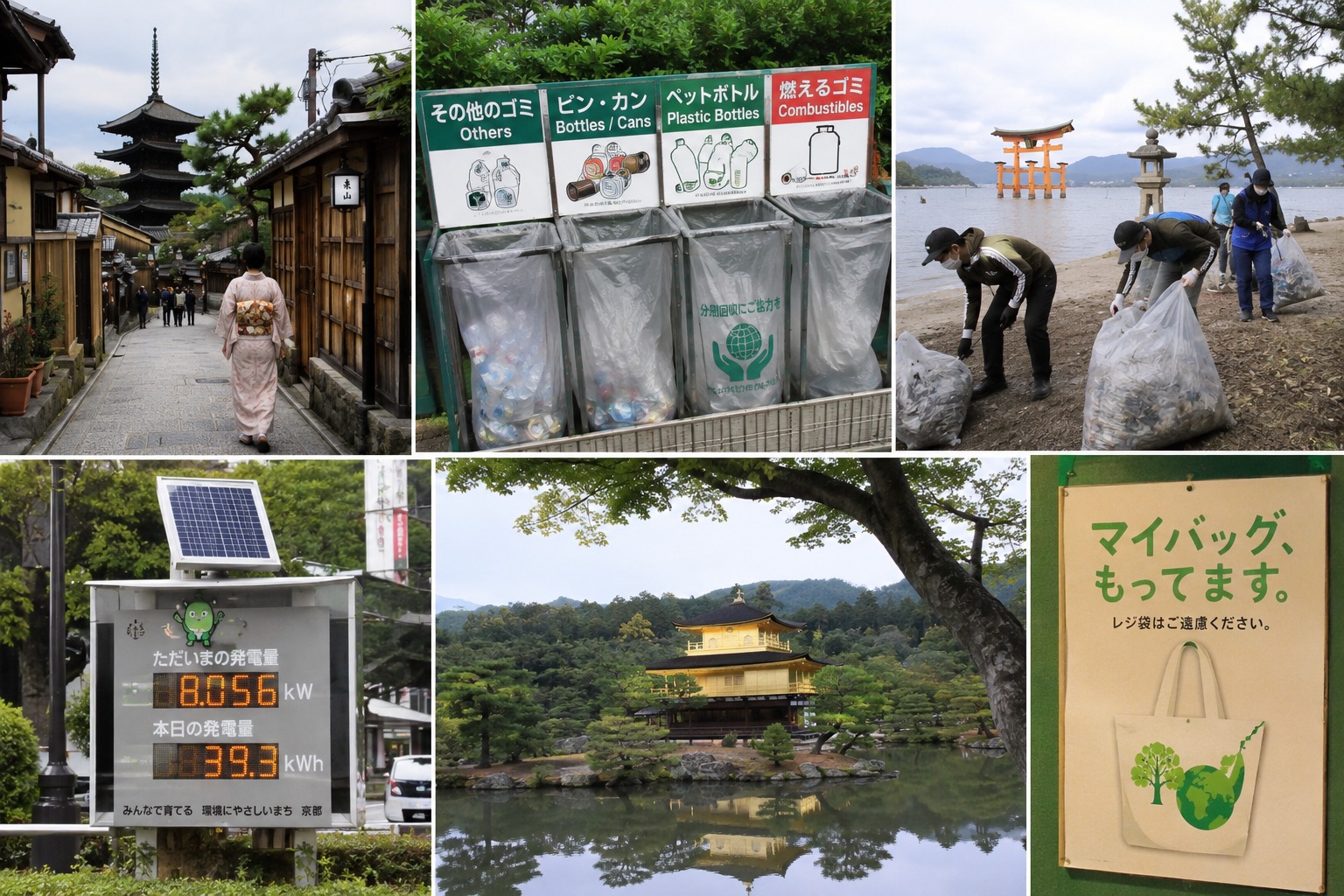
Today, any tourist or foreign visitor walking through the streets of Tokyo, Osaka, Kyoto, or other Japanese cities is struck by their extraordinary cleanliness. At the same time, one encounters an apparent paradox: public trash bins are almost nowhere to be found. If such a situation existed in many other countries in Europe or Asia, it is likely that the streets would quickly become overwhelmed with litter. Why does this not happen in Japan? On the contrary, despite the absence of public waste bins, Japanese cities remain impeccably clean, as though they had just been washed and carefully maintained. What explains this phenomenon?
This level of cleanliness is not achieved through an army of sanitation workers, administrative coercion, or heavy fines. At its heart stands the ordinary Japanese citizen. One only has to recall the images of Japanese football fans meticulously collecting every piece of litter after matches in large stadiums. Although everyday life in Japan is far less littered than those post-match scenes, this behavior is a routine part of life for millions of citizens. Every day, millions of Japanese people simply place their waste in their bags and take it home for disposal. This is a deeply ingrained habit cultivated from an early age. Even in primary school, children clean their own classrooms and school corridors at the end of each school day. Through this practice, environmental responsibility becomes embedded in individual consciousness from childhood. It represents a historically rooted sense of responsibility toward both society and nature—a distinctive model of ecological behavior.
How, then, did such an attitude toward waste become an integral part of everyday life in Japan?
Japanese cleanliness: religion and ethics or rules and penalties?
Many people trace the origins of this phenomenon to the 1995 sarin gas attack on the Tokyo subway. Following the attack, public trash bins were removed from many public spaces for security reasons. It is often argued that this gave rise to the now-familiar practice of “taking your trash home with you.” Rather than complaining about the government’s decision, Japanese citizens accepted personal responsibility for managing their own waste and regarded it as an important civic duty.
In my view, however, a habit that has become so deeply rooted in social behavior cannot be explained solely by a government directive. Its origins must run much deeper. This inevitably brings to mind the German sociologist Max Weber. In his seminal work The Protestant Ethic and the Spirit of Capitalism, Weber argued that religion is not merely a matter of belief in the afterlife. Rather, he viewed religion as one of the principal forces shaping people’s everyday social and economic behavior. According to Weber, the remarkable progress, Renaissance, and economic transformation of the West were closely connected with Protestantism’s ethic of worldly asceticism—its understanding of work as a form of worship. From this perspective, it is worth turning to Shintoism, Japan’s indigenous religion, which is deeply intertwined with the country’s cultural identity, as well as to Zen Buddhism.
In Shinto belief, impurity and disorder are regarded as signs of spiritual corruption. They create conditions in which evil forces may enter human life and cause harm. Cleanliness, by contrast, brings people closer to the divine. Keeping one’s surroundings clean is therefore not merely a matter of hygiene; it is also a way of purifying one’s inner world and spirit. Likewise, in Zen Buddhism, sweeping a room symbolizes far more than a physical act of cleaning—it represents the cleansing of one’s ego and the quieting of mental disorder.
When we consider these factors, it becomes difficult to view the daily practice of millions of people carrying their own waste home as merely a matter of discipline or compliance. Rather, this habit appears to have been shaped over centuries by deeply rooted beliefs until it became almost instinctive.
In Japan, ecological culture precedes the law. This is because religious beliefs and moral values profoundly influence people’s attitudes toward rules and regulations. In many Western legal traditions—whether the Romano-Germanic or Anglo-Saxon systems—as well as under Islamic law, compliance is generally secured through legal sanctions, law enforcement agencies, penalties, surveillance cameras, and other external mechanisms. For the Japanese, however, environmental responsibility begins long before the law intervenes; it originates within their moral consciousness. Avoiding inconvenience or harm to others is regarded as a fundamental aspect of the Japanese mindset. From this perspective, throwing litter onto the street is not merely an act of environmental pollution—it is also a profound sign of disrespect toward society. The responsibility for the common good takes precedence over individual convenience. Consequently, moral norms and social disapproval exert their influence before legal rules or penalties come into play. In this sense, a person’s conscience and the values of the community to which they belong serve as the primary guardians of responsible behavior.
Of course, no one is born with a fully developed moral conscience. The formation of character depends on essential institutions such as the family, the school, the surrounding social environment, and education. Japan’s ecological culture is likewise the product of the combined efforts of families, schools, and local communities in cultivating shared values and responsible habits.
In Japanese households, waste is sorted with remarkable precision. In some municipalities, garbage is divided into more than forty different categories. For example, the plastic container, its cap, and its label are washed and sorted separately before disposal. Schools, meanwhile, generally do not employ janitorial staff. Nor is there any real need to do so, because children are taught from an early age that they are personally responsible for the waste they produce. This practice goes far beyond physical cleanliness; it teaches equality, respect for labor, and the importance of caring for shared spaces. Community clean-up days, during which older and younger generations voluntarily collect litter together, further reinforce these values and complete the cycle of environmental education.
These examples demonstrate that success in waste management and recycling cannot be attributed solely to advanced recycling technologies or innovative solutions. Even today, many highly developed countries struggle to keep their major cities free from litter despite allocating enormous budgets to waste management. This reality once again highlights that the decisive factor in maintaining cleanliness and protecting the environment is the human element—namely, social and moral responsibility. Japan’s experience clearly illustrates that the most important foundation is a culture of responsible behavior toward waste.
In conclusion, environmental crises cannot be overcome through legislation alone. Ecological responsibility must become an integral part of society’s everyday code of conduct.
Fuad Huseynzade